
The University of Virginia is so much a part of everyday life in Charlottesville that it can be easy to overlook the full scope of its massive influence on the area. Many people think first about students and professors, the Lawn, and football Saturdays. But UVA’s reach extends much further.
A study by UVA’s Weldon Cooper Center for Public Service examines the University’s role in employment, research, healthcare, entrepreneurship, tourism, and community partnerships. Among its findings, the report concludes that University-related activity supports more than 50,000 jobs across the Thomas Jefferson Planning District. That’s just one part of a much larger story.
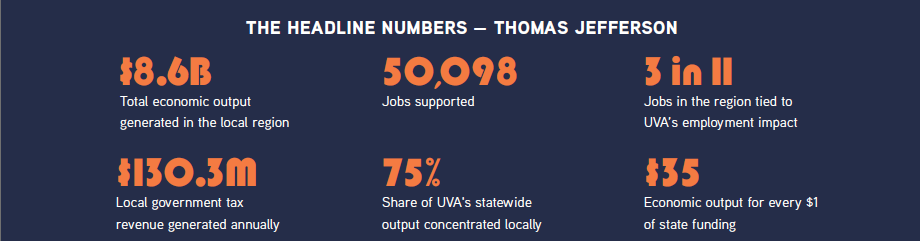
Employment is the most visible way that UVA shapes the region. The University’s Academic Division and Health System directly employ more than 30,000 people, making UVA the area’s largest employer. Its economic footprint extends well beyond the Grounds. Construction firms build new facilities, while local companies provide food service, printing, maintenance, security, software, laboratory equipment, furniture, and professional services. Hotels, restaurants, and retailers benefit from a steady stream of visitors throughout the year. The Weldon Cooper study estimates that University-related activity supports more than 50,000 jobs across the region.
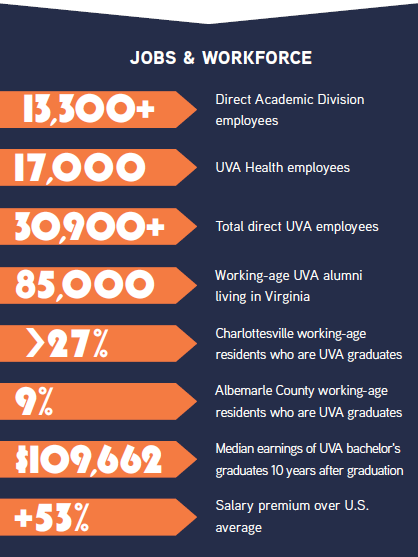
UVA also shapes the local workforce in another way. Thousands of students arrive in Charlottesville each year, many of whom choose to remain in Virginia after graduation. According to the report, over 85,000 working-age UVA alumni now reside in the Commonwealth. Charlottesville boasts the highest concentration of working-age UVA graduates of any locality in Virginia, which helps explain the continued expansion of employers in fields such as finance, engineering, law, technology, healthcare, and consulting within the region.
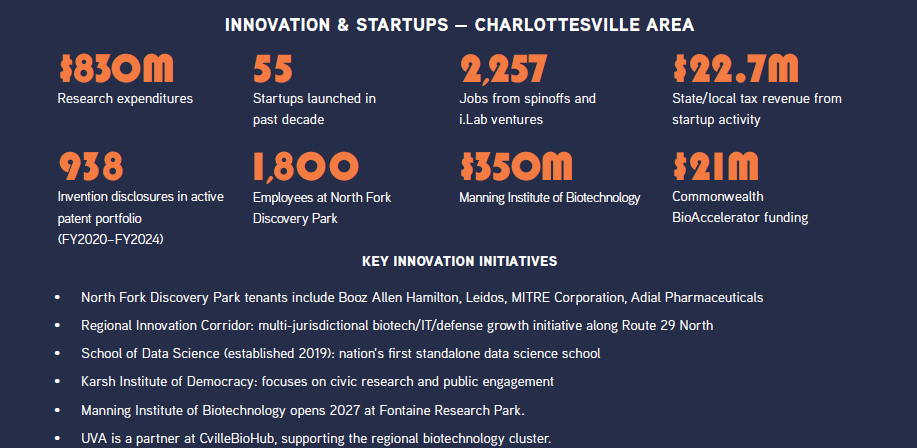
Research adds another layer of impact. UVA spent over $830 million on research in fiscal year 2024. While much of this work occurs within laboratories, clinics, and research centers, some projects extend beyond the Grounds through patents, startup companies, and partnerships with private industry.
Over the past decade, UVA-supported ventures have launched dozens of startup companies, most of which remain in the Charlottesville area. These businesses employ thousands and contribute to a growing biotechnology and life sciences sector centered around Fontaine Research Park and North Fork Discovery Park.
This momentum continues with ongoing or recently completed projects. The Manning Institute of Biotechnology is set to become a major center for translational medicine and biotechnology research. The Commonwealth BioAccelerator, located at North Fork Discovery Park, provides early-stage biotechnology companies with essential laboratory space and business support that was previously unavailable in the region.
Visitors represent another often-overlooked aspect of the local economy. While football Saturdays garner significant attention, athletics account for only a portion of the picture. Families visit for admissions programs, alumni return for Reunions and Homecomings, and audiences attend performances at John Paul Jones Arena. The Virginia Film Festival and Virginia Festival of the Book annually draw visitors downtown, while public lectures, museum exhibitions, and concerts attract residents and guests throughout the year. Healthcare also generates its own visitor economy. Families accompany patients receiving specialized care at UVA Health, often staying in local hotels, dining at nearby restaurants, and spending several days in the community.
- VISITOR ECONOMY
- UVA Academic Division: 652,004 total visitors to Grounds; 333,738 out-of-region visitors;
$93.3M direct visitor spending
- UVA Health: 274,810 patient companions/visitors; 96,388 out-of-region visitors; $8.7M direct visitor spending
- More Visitation Highlights:
- Athletics: 445,894 attendees, with 245,491 coming from outside the region (spending $56.4M)
- John Paul Jones Arena (non-basketball events): 102,296 ($19.3M)
- Admissions events: 52,458
- Alumni events: 29,833
- Virginia Film Festival: 19,698
- Festival of the Book: 1,825
- More Visitation Highlights:
The University’s presence extends into the community in less visible ways. Madison House places students with dozens of local nonprofit organizations annually. UVA faculty, staff, and students volunteer throughout the region. Law students provide free legal assistance through clinical programs, and student-athletes participate in community service. The University also contributes to local emergency services and provides hundreds of millions of dollars in indigent care and unreimbursed Medicaid through UVA Health.
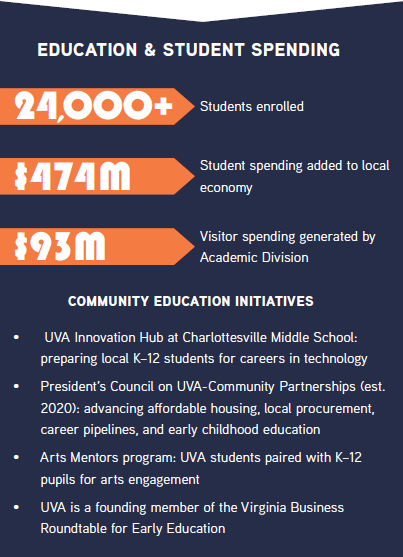
Some of UVA’s efforts focus on long-term community priorities. The President’s Council on UVA-Community Partnerships collaborates with local governments, schools, nonprofit organizations, and businesses on issues including workforce development, affordable housing, early childhood education, and economic opportunity. Programs such as the UVA Innovation Hub at Charlottesville Middle School introduce local students to technology and career pathways before they reach college.
DATA FOR DECISION-MAKERS
The University of Virginia’s Weldon Cooper Center for Public Service is a nonpartisan research and training hub that helps governments and communities make better decisions across the Commonwealth. The Center’s demographers produce Virginia’s official population estimates and projections, which guide everything from school construction and transportation planning to funding allocations and local budgeting. Its economists and policy analysts study workforce trends, taxes, economic development, and energy issues, translating complex data into usable insights for public officials, nonprofits, and civic leaders. The Center also offers leadership development and practical training programs for state and local officials, helping to build effective, data‑literate governance at every level in Virginia.
Data in this article is sourced from The Economic Impact of the University of Virginia (FY2024 data), released October 2025 by the Weldon Cooper Center for Public Service.