
Where Students and Townspeople Meet
Every university leaves its mark on the surrounding community. Some impacts are easy to measure through jobs, research, healthcare, and economic activity, while others are built more quietly through relationships that develop over time. For more than half a century, Madison House has helped shape one of the University of Virginia’s most enduring connections with the Charlottesville area by connecting students with opportunities to volunteer with local schools, nonprofits, healthcare providers, and community organizations.
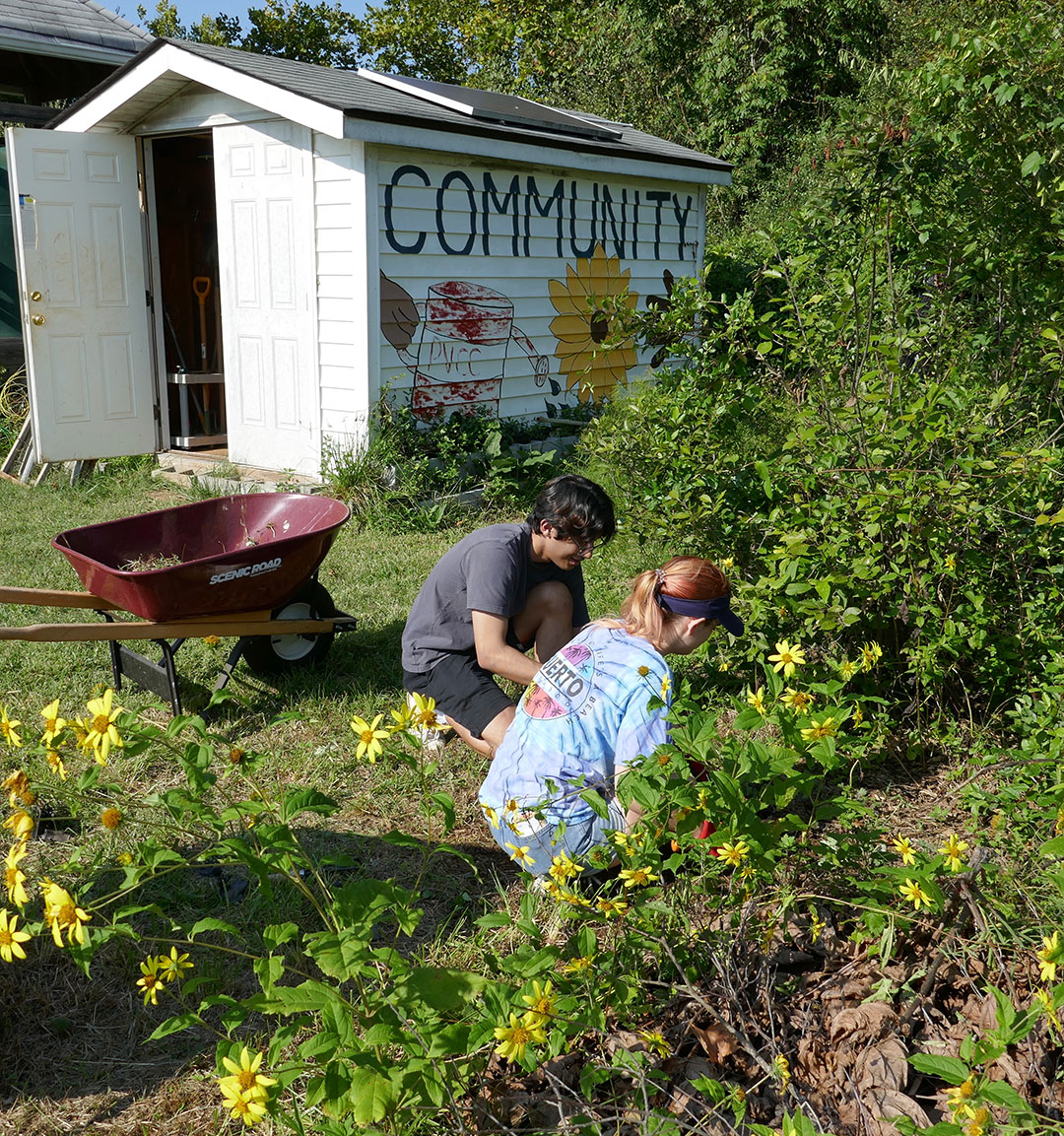
Founded in 1969 as UVA’s independent student volunteer center, Madison House has grown into one of the region’s largest organized networks of volunteers. Each year, nearly 2,000 students contribute tens of thousands of hours of service at more than 120 community sites, working everywhere from elementary schools and food pantries to hospitals, refugee assistance programs, animal sanctuaries, and community gardens. Madison House acts as a bridge between the university and the community, matching student interests with community-identified priorities while providing local organizations with a dependable corps of trained volunteers.
The impact runs in both directions. Community organizations gain volunteers who expand their capacity to serve local residents, while students step beyond the classroom to engage with the people, neighborhoods, and challenges that define the place they call home during their years at UVA.
“Student leaders are the heart of Madison House,” says Mary Denlinger, Madison House’s executive director. “The scale of programming and the level of responsibility students take on are remarkable. Student leadership is central to every part of the organization, from our programs to our board.”
This student-led model distinguishes Madison House from many volunteer organizations. Students recruit volunteers, coordinate schedules, organize training, work with community partners, and oversee the organization’s four major service tracks. The experience extends far beyond volunteering itself. Students learn to manage teams, solve problems, build partnerships, and take responsibility for programs that serve thousands of people across the Charlottesville area.
Madison House traces its roots to the nation’s first collegiate YMCA, before students established the organization in 1969 to coordinate volunteer efforts throughout the community. More than 50,000 students have participated since then. “Madison House has a strong legacy of service,” Denlinger says. “We’re honored to carry it forward for the next generation of students.”
She believes this legacy reflects something fundamental about the university itself. “Madison House embodies UVA’s longstanding commitment to public service,” she says. “We provide hands-on opportunities for students to put those values into practice in partnership with the Charlottesville community.”
The breadth of Madison House’s work is remarkable. Students tutor children, mentor teenagers, assist patients in hospitals and clinics, coach youth sports, prepare tax returns for low-income families, support refugee resettlement, care for rescued animals, answer crisis helplines, and help address food insecurity. Although the programs address diverse community needs, they share a common philosophy. Madison House listens first, then recruits and prepares students to serve where they’re needed most.
Those long-term commitments shape students as much as they strengthen community organizations. For Ellie Maruca, those weekly commitments became the defining experience of her time at UVA. Maruca, who graduated in May with degrees in public health and Spanish, spent three years volunteering through Madison House’s Adopt-a-Grandparent program, visiting residents in memory care at Commonwealth Senior Living and later at The Colonnades. The experience reshaped both her understanding of service and the direction of her career.
The experience also led her toward nursing. Through Madison House, Maruca volunteered on a telemetry unit at Martha Jefferson Hospital, where she worked alongside nurses and discovered how much she valued direct patient care. “Madison House gave me clinical experiences I wouldn’t have had otherwise,” she says. “Being in that environment helped me realize how important direct care is to me. That’s what makes nursing stand out—the caring aspect, being hands-on, and being the one who’s there for people’s needs.”
Her work in memory care left an equally lasting impression. Watching residents cope with isolation inspired her public health capstone on depression among older adults and reinforced her belief that simply showing up each week can make a meaningful difference. “What I’ll carry with me is the importance of getting to know the people around you when you’re serving and meeting them where they are,” she says. “Madison House changed my idea of what service really is. I’ve come to see it as fundamentally about building relationships.”
Denlinger sees stories like Maruca’s year after year. While Madison House exists to strengthen the community, she says students often discover that the experience changes them just as profoundly. “Students often tell us they get more out of their service than they give,” Denlinger says. “They’re building relationships with people they might not otherwise meet, gaining a deeper understanding of the Charlottesville community, and learning from community partners who are experts in their fields and serve as co-educators.”
Third-year student Mahir Parmar first volunteered at UVA Health through Madison House after arriving from Pittsburgh. Today, he directs Madison House’s Health and Medical Services track. “I grew up volunteering. My parents really instilled that in me,” he says. “When I got to UVA, I knew I wanted to keep serving, and the first name that came up was Madison House. I heard about it at orientation, and I signed up for a shift at UVA Health. I’ve loved it ever since.”
Over the past two years, Parmar has volunteered in the hospital’s gift shop and medical laboratory, helping family members who cannot be in Charlottesville send cards, flowers, balloons, and small gifts to loved ones receiving care. Delivering those simple gestures has shown him how much small acts of kindness can matter. “One of my favorite memories is bringing a small blue teddy bear to a newborn,” he says. “I still have my teddy bear from when I was born, so getting to carry that little gift up to a new baby felt really special. Moments like that stay with you.”
Those experiences have also changed the way he views healthcare. “From the outside, you might think you have one doctor taking care of you,” he says. “But what I see is a whole team—nurses, doctors, techs, and so many others—constantly coming in and checking on patients. Those small gestures of compassion, over and over, are beautiful to witness. It’s people coming together around one patient who’s going through something hard, and that’s what keeps me drawn to the medical field.”
Today, Parmar oversees one of Madison House’s largest service tracks, coordinating head program directors and dozens of student leaders who, in turn, manage volunteers serving throughout the region’s healthcare community. The responsibility has given him an appreciation for the scale of an organization that is almost entirely run by students. “What makes Madison House special is its sheer size and its long history,” Parmar says. “We’re able to place so many more students in hospitals and community organizations than would ever be possible if everyone had to figure it out on their own.”
That scale is felt most clearly by the organizations that welcome Madison House volunteers each week. For many nonprofits, the students represent far more than extra hands. Their steady presence allows organizations to expand programs, serve more people, and devote more resources to fulfilling their missions.
Ranger’s Refuge at Gallastar Farms in Esmont is one of those partners. The nonprofit animal sanctuary and equine-assisted therapy center relies on Madison House students to help care for rescued animals, maintain the property, and complete projects that keep the 68-acre farm operating.
“Our relationship with Madison House volunteers is a cornerstone of Gallastar,” says Lorelei Pulliam, who co-founded the organization with her husband, Ron. “We literally could not keep Gallastar up and running without Madison House. They are our only volunteers, and we depend on them to finish projects on the farm. They also perform many animal-related care activities.”
For Pulliam, the partnership extends well beyond the work itself. “Just as importantly, they give us hope and inspiration,” she says. “We can rest assured that the future of our world is brighter with generous, genuinely kind and industrious young people at the helm.”
Jane Colony Mills has experienced Madison House from both sides of the partnership. As a UVA student, she volunteered through Madison House providing childcare at Trinity Episcopal Church. Today, as executive director of Loaves & Fishes Food Pantry, she depends on Madison House students to help feed thousands of families across the region.
“Volunteering connected me to the greater Charlottesville community and gave me an insight into who makes up this beautiful, welcoming area,” Mills says. “Madison House volunteering probably led to my eventually landing on a nonprofit career path. I could see what I had to offer, that made me feel good, and made me want to give back to support my community.”
Today, Madison House volunteers are integral to the daily operation of Loaves & Fishes, helping distribute food, organize donations, and assist visitors throughout the pantry. “Volunteers make up half of our organization’s labor force,” Mills says. “We could not feed so many people without community and student volunteers.”
Her experience illustrates one of Madison House’s greatest strengths. The organization provides nonprofits with students who become part of their regular operations, returning often enough to understand the work, build relationships, and earn the trust of the people they serve. Madison House encourages students to think beyond individual volunteer shifts and instead see themselves as partners in long-term community relationships.
“Part of our mission is to foster a lifelong commitment to service,” Denlinger says. “For many, that journey begins at Madison House, and we encourage them to explore how they’ll continue contributing to the common good after graduation, regardless of their major or career.”