
A Better Way to Organize
Homes rarely become dysfunctional overnight. More often, they fall out of sync with the people living in them. Families grow, careers change, children leave home, and new routines gradually replace old ones until a house becomes less functional. Counters collect clutter, closets become difficult to navigate, and everyday tasks take longer than they should.
For Keri Byrne, founder of Charlottesville Organizing, that’s the story behind nearly every client she meets. People often seek help organizing a pantry, reclaiming a garage, or clearing out a spare bedroom. Byrne has learned those projects are rarely about the rooms themselves. Instead, they are opportunities to reshape a home around the way people live.
“The whole purpose of decluttering and organizing is to go through your spaces and make intentional decisions about everything,” Byrne explains. “Am I keeping this? Will I use it? Is this where it should live?”
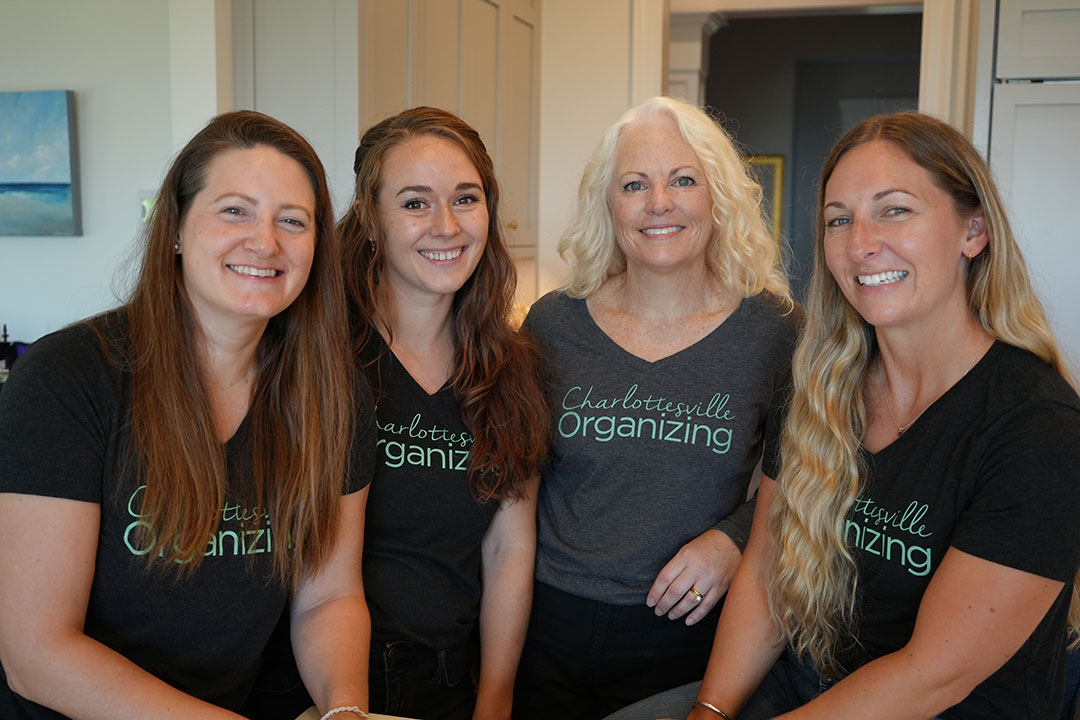
Those questions form the foundation of every project Byrne undertakes with fellow organizers Stephanie Kitchen, Rachael McCabe, and Devan Cooper. Before recommending storage containers or reorganizing a closet, they spend time understanding how a family moves through its day, where routines tend to break down, and which possessions still serve a purpose. Professional organizing, they say, has far less to do with creating beautiful spaces than creating homes that function comfortably and naturally for their residents.
“When people accumulate clutter, it’s not always about being disorganized or lazy,” McCabe says. “It’s often the result of busy schedules and life’s changing seasons. Homes don’t evolve as fast as families do, and that’s where they get backlogged.”
Recognizing that pattern changes the way Byrne and her colleagues approach their work. Rather than focusing on what should be thrown away, they begin by helping clients think intentionally about the lives they’re living today. The question isn’t just where something belongs. It’s whether it still belongs at all and, if it does, whether it’s occupying the space that best reflects its importance in daily life.
“If an organizing system is too complicated, it will fail,” Kitchen says. “In a playroom, kids should be able to put the toys away on their own. If it takes more than ten minutes to clean up, you either have too much stuff or the system is too complex.”
While creating better systems is one part of organizing, deciding what belongs in those systems is the other. That’s the point where many projects become less about shelves and storage bins and more about judgment. Clients who were eager to empty closets or sort through a garage often find themselves slowing down as they begin weighing the value of individual possessions.
One explanation frequently arises: “I might need it someday.” Rather than asking clients if they’re ready to let something go, Byrne encourages them to ask why they’re keeping it. That subtle shift moves the conversation away from imagined possibilities and back to present realities.
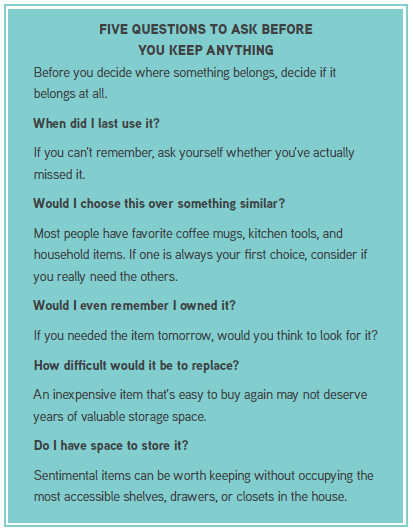
McCabe has found that a few carefully chosen questions often help clients answer that for themselves. She asks when they last used an item and whether they would have noticed if it had disappeared. The answers help people distinguish between possessions that actively support their daily lives and those that have quietly become part of the background.
Comparing similar items often reveals that a few favorites earn regular use while others remain simply because no one has questioned them. Byrne also asks clients to consider replacement costs. An inexpensive, easily replaceable item may not deserve years of valuable storage space. Conversations become more complicated when sentimental value enters the picture. Clothing from a previous career, keepsakes from a child’s early years, or belongings inherited from a parent carry meaning that has little to do with how often they’re used. Kitchen says those decisions require a different kind of conversation because they aren’t really about organization. They’re about acknowledging that people naturally attach memories to objects and that letting go of an item doesn’t necessarily mean letting go of a memory.
The same principle applies throughout the home. Organizing isn’t about erasing the past or stripping away reminders of meaningful moments. It’s about creating space for the life happening today while preserving the memories that matter most. Byrne often reminds clients that sentimental items deserve thoughtful homes, too, but those homes don’t always need to be the shelves, drawers, and closets that support everyday living. Once people recognize this distinction, organizing becomes less about deciding what to get rid of and more about intentionally choosing what belongs at the center of their lives.
If practical decisions require careful thought, emotional ones demand patience. Many clients have lived with clutter for years seeking help, and by then the challenge often extends beyond overflowing closets or crowded countertops. Possessions often represent relationships, accomplishments, or seasons of life that people aren’t quite ready to leave behind. The organizers understand that their role isn’t to rush those decisions but to help clients navigate them without judgment.
“There’s a lot of communication involved in what we do,” Kitchen says. “Many clients are embarrassed that things have gotten to the point they have, and they’re struggling to reclaim their space and their time. Our job is to be supportive, not judgmental, and to help them move forward.”
That approach reflects another lesson the team has learned—people become overwhelmed not because they’re unwilling to make decisions, but because they’re asked to make too many at once. After hours of sorting, even the most motivated clients experience decision fatigue, which is why the organizers recommend focusing on one drawer, shelf, or cabinet at a time.
The same patience applies to sentimental belongings. McCabe says clients sometimes tell her they’re simply not ready to decide about a particular box or collection, and she believes that’s perfectly reasonable. Instead of forcing the issue, she encourages them to separate the decision about if something should remain in their lives from the decision about where it belongs. A thoughtfully assembled keepsake box can preserve family history without allowing every sentimental object to compete for space in the rooms people use every day.
McCabe recalls a powerful example of how a little reassurance can help. A mother struggled to part with a stack of her children’s artwork, worried that throwing away even one drawing somehow reflected on her as a parent. McCabe reminded her that the memories weren’t contained in the paper itself, and that choosing a few meaningful pieces didn’t diminish the love or care behind the rest.
Byrne says those moments often become turning points because clients realize they’re no longer just organizing possessions—they’re making peace with the expectations they’ve placed on themselves. As rooms become easier to maintain and daily routines require less effort, many people discover they feel calmer, more capable, and less burdened by the constant sense of needing to catch up.
“I’ve had one client tell me she stopped seeing her therapist, started exercising, and now her friends ask her to help organize their homes,” Byrne recalls. “For some people it’s just a nicety that makes life smoother. For others, it really is life-changing.”
The organizers don’t suggest every project is life-changing, but they firmly believe every home should support the people who live there instead of demanding their constant attention. “We’re not aiming for picture-perfect,” Kitchen says. “We’re aiming for spaces that are good for people and realistic for their families.”
Ultimately, this may be the simplest way to understand what professional organizers really do. They don’t help people build perfect homes. They help them build homes that make everyday life a little easier, a little calmer, and a little more intentional. These are changes that don’t just clear a closet or organize a pantry—they create space for whatever comes next.